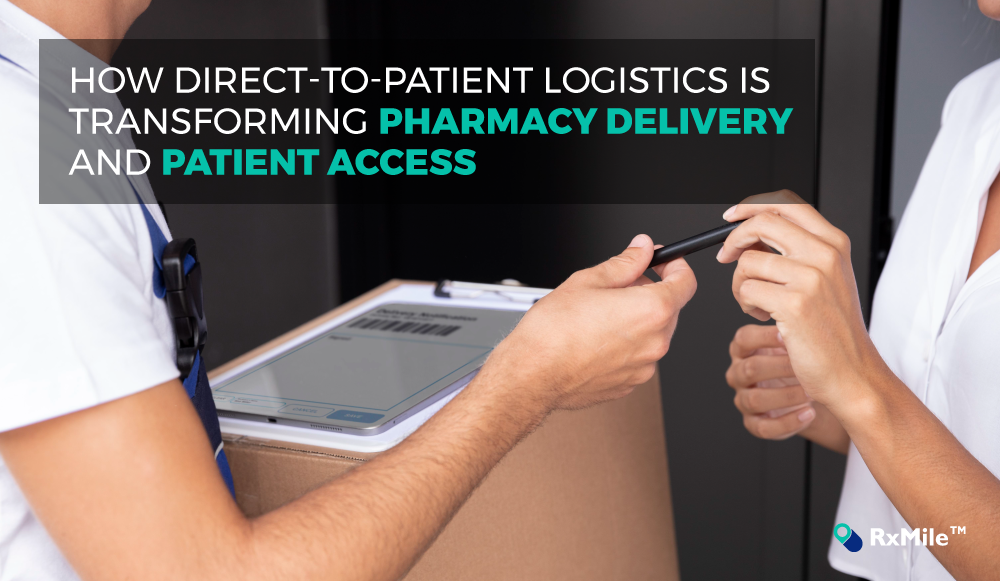
How Direct-to-Patient Logistics Is Transforming Pharmacy Delivery and Patient Access
Estimated reading time
The way pharmacies deliver medication to patients is changing at a pace that few could have predicted even five years ago. For pharmacy owners, that change presents both a significant challenge and a genuine opportunity to differentiate, grow, and better serve the communities that depend on them.
Direct-to-patient (DTP) logistics is no longer a niche concept reserved for large mail-order pharmacy operations or specialty drug distributors. It has become a mainstream expectation, driven by patient demand, healthcare system pressure on adherence outcomes, and rapid advances in delivery technology. Patients now expect their prescriptions to arrive reliably, safely, and at their convenience, much as they expect any essential product to be delivered to their door.
For pharmacies, embracing direct-to-patient logistics effectively means more than simply offering delivery as an option. It means building the operational infrastructure, compliance frameworks, and technology capabilities to make that delivery consistent, scalable, and financially sustainable across an entire patient population. This post unpacks what DTP logistics really means for pharmacies, why it has moved to the center of pharmacy strategy, and how to build a program that works.
Offering delivery is the easy part. Building a program that scales is where most pharmacies get stuck.
What is direct-to-patient logistics?
What is direct-to-patient logistics?
Direct-to-patient logistics refers to the systematic delivery of pharmaceutical products, including prescription medications, over-the-counter products, and related medical supplies, directly from a pharmacy or distribution point to a patient's home or chosen delivery location.
While the core concept is straightforward, the execution involves a layered set of operational and regulatory considerations. Route efficiency, proof-of-delivery capture, HIPAA-compliant handling of patient data, co-pay collection at the door, temperature-sensitive product management, chain-of-custody documentation, and audit-ready record keeping are all part of a properly functioning DTP operation. None of these elements are optional, and most of them require purpose-built technology to manage effectively at any meaningful scale.
DTP logistics is also meaningfully distinct from informal or ad-hoc delivery arrangements. Having a staff member drop off a prescription on their way home or contract with a general courier service that has no pharmacy-specific training or compliance infrastructure, is not a DTP logistics program. At scale, DTP requires dedicated workflows, integrated technology, and either in-house courier capacity with appropriate training and oversight, or access to a managed pharmacy courier network that handles compliance and documentation as part of its service offering.
Why DTP logistics has moved to the center of pharmacy strategy
Why DTP logistics has moved to the center of pharmacy strategy
Shifting patient expectations
The pandemic permanently accelerated consumer expectations around home delivery across virtually every product category, and pharmaceuticals were no exception. Patients who experienced prescription home delivery for the first time during 2020 and 2021 largely did not return to in-store collection as their primary access method. That behavioral shift has proven durable. Adherence research consistently shows that patients who receive their medications at home are more likely to fill prescriptions on time, less likely to experience gaps in therapy, and more likely to remain loyal to the pharmacy that provides that service.
For pharmacies serving populations with high proportions of elderly patients, patients with chronic conditions, or patients in rural and semi-rural areas, the case for DTP investment is particularly strong. These are exactly the patients for whom getting to the pharmacy is hardest and for whom home delivery has the greatest impact on adherence and outcomes.
Healthcare system pressure to improve adherence
Payers, pharmacy benefit managers, and integrated health systems are increasingly focused on medication adherence as a measurable and financially significant outcome metric. Pharmacies that can demonstrate high delivery reliability, low missed-dose rates, and strong patient engagement are better positioned in value-based care conversations, preferred pharmacy network negotiations, and accountable care organization relationships. As the healthcare system continues to shift toward outcomes-based reimbursement models, pharmacy delivery capability is moving from a patient amenity to a strategic credential.
The competitive landscape
Large retail pharmacy chains and integrated health systems have invested heavily in DTP capabilities over the past several years. Amazon Pharmacy, CVS, Walgreens, and a growing number of digital-first pharmacy platforms have built delivery infrastructure that sets a high bar for patient expectations. For pharmacies, building a credible, technology-enabled direct-to-patient delivery program is no longer optional if they want to retain patients who have come to expect it from other providers.
The good news is that pharmacies hold a relationship advantage that larger operators cannot easily replicate. Local knowledge, personalized service, pharmacist accessibility, and genuine community trust are differentiators that matter deeply to patients, particularly older patients and those managing complex chronic conditions. The key is pairing that relationship advantage with delivery infrastructure and technology that meets patients where they are and matches the reliability they have come to expect.
The core operational components of effective DTP logistics
The core operational components of effective DTP logistics
1. Route optimization
Efficient DTP delivery at any meaningful scale requires intelligent route planning. Manual routing is time-consuming, error-prone, and expensive relative to what software-driven optimization can achieve. Route optimization technology reduces driver mileage, shortens delivery windows, increases the number of patients a driver can serve in a given shift, and directly improves the unit economics of the delivery operation. For pharmacies building out delivery programs, route optimization is not a luxury feature. It is a foundational requirement for making home delivery financially sustainable.
2. Real-time tracking and patient communication
Patients expect visibility into the status of their delivery. Real-time tracking notifications, sent to patients and where relevant to caregivers or physician offices, reduce inbound calls to the pharmacy asking about delivery status, increase patient confidence in the delivery process, and create a professional, branded experience that reinforces the pharmacy relationship. For elderly patients or those managing anxiety around their medication supply, the reassurance of knowing exactly when their delivery will arrive has real clinical and experiential value. Tracking that works without requiring patients to download an app or navigate a complex digital interface is especially important for serving older patient populations.
3. Proof of delivery and compliance documentation
Every prescription delivery requires auditable proof that the medication reached the intended recipient. Contactless electronic signature capture, timestamped GPS coordinates, and photographic delivery confirmation together provide the documentation trail that protects pharmacies during payer and regulatory audits and demonstrates the integrity of the delivery process. Pharmacies that rely on paper-based proof of delivery, or that do not have consistent documentation processes in place, are creating compliance risk with every delivery they make. The audit exposure that comes from inadequate POD documentation can be significant, including recoupment claims from PBMs that can reach back years.
4. Co-pay collection at the point of delivery
Uncollected co-pays represent a meaningful and largely preventable source of revenue leakage for pharmacies operating home delivery programs. When co-pay collection is not integrated into the delivery workflow, pharmacies face a choice between post-delivery billing, which creates accounts receivable complexity and collection friction, or absorbing the co-pay as a cost of delivery, which is unsustainable at scale. Integrating co-pay collection at the door, enabling drivers to collect payment securely at the point of delivery, solves this problem cleanly and removes a barrier to patient access at the same time.
5. HIPAA-compliant data handling through the workflow
DTP logistics necessarily involves handling protected health information at multiple points in the delivery process, from delivery scheduling and driver instructions through to delivery confirmation records and exception documentation. Pharmacies must ensure that every element of their DTP workflow operates within HIPAA-compliant parameters, including the technology platforms they use for routing and communication, the courier arrangements they rely on for physical delivery, and the record storage systems where delivery documentation is retained. Non-compliance in this area carries significant regulatory and reputational risk that no pharmacy can afford to ignore.
Building a DTP operation does not have to mean managing five different systems.
In-house delivery vs. managed courier networks
In-house delivery vs. managed courier networks
One of the most significant strategic decisions facing pharmacy owners as they develop DTP capabilities is whether to build an in-house delivery operation or partner with a managed pharmacy courier network.
In-house delivery offers control and the ability to maintain the pharmacy's brand presence and service culture throughout the delivery experience. However, it carries substantial fixed costs, including driver employment, vehicle management, insurance, fuel, and ongoing operational oversight. For many pharmacies, particularly those operating in markets with variable delivery demand or those just beginning to build delivery volume, those fixed costs are difficult to justify against uncertain initial revenue from the delivery program.
Managed courier networks, where pharmacies access pre-vetted, pharmacy-trained delivery drivers through a platform provider, offer flexibility, scalability, and significantly lower fixed costs. They also transfer a substantial portion of the operational and compliance burden to the network provider, allowing pharmacy staff to focus on clinical and dispensing functions rather than delivery logistics management.
The financial case for DTP investment
The financial case for DTP investment
Pharmacy owners sometimes approach DTP investment with concern about upfront cost and operational complexity. The more useful analytical framework is to weigh that investment against the cost of not building DTP capability.
Patient attrition driven by competitors who offer delivery experiences that your pharmacy cannot match is a real and ongoing cost. Revenue leakage from uncollected co-pays, staff time absorbed by manual delivery logistics, and the compliance risk of inadequate documentation all carry financial consequences. Pharmacies that build effective DTP programs consistently report meaningful improvements in patient retention, increased prescription volumes from existing patients, and stronger revenue per patient over time.
Beyond direct financial metrics, DTP capability positions pharmacies competitively for preferred pharmacy network status, value-based care partnerships, and long-term relationships with health systems and payers that increasingly require delivery-capable pharmacy partners as a qualification for participation.
Better retention. More prescriptions. Less revenue leakage.
DTP is a strategic capability, not a feature
DTP is a strategic capability, not a feature
Direct-to-patient logistics is not an add-on service for pharmacies. It is a core strategic capability that shapes patient relationships, clinical outcomes, competitive positioning, and long-term financial performance. Pharmacies that build it thoughtfully, with the right technology and operational partners, will be significantly better positioned to grow and retain their patient base through the rest of this decade and beyond. RxMile's prescription delivery software gives pharmacies the complete platform to build, manage, and scale direct-to-patient delivery operations. From route optimization and real-time tracking to managed courier network access and audit-ready compliance documentation, RxMile puts the infrastructure of a world-class delivery operation within reach of every independent pharmacy. Explore the full platform by starting a 30-day free trial.

 320 W Sabal Palm Ste 300,