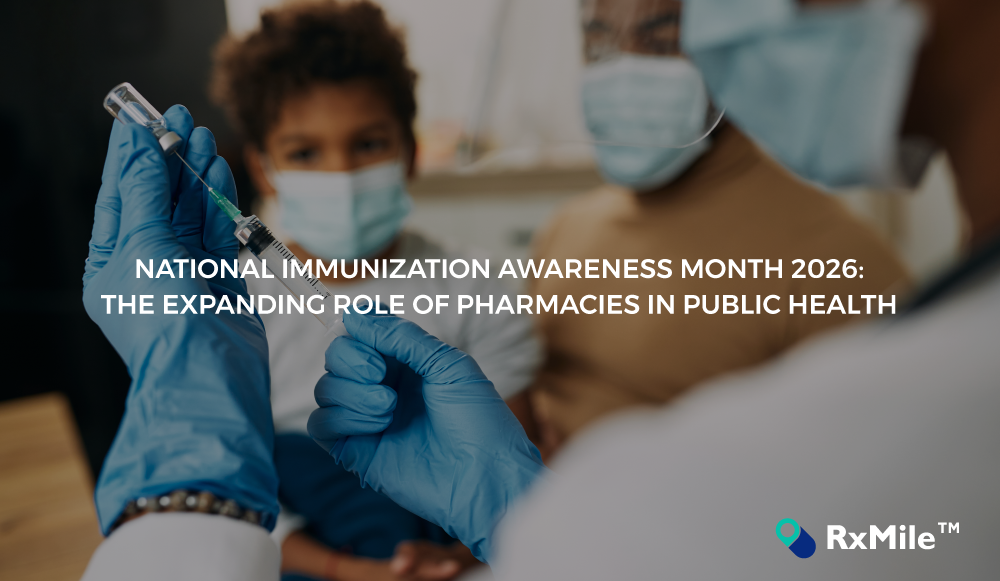
National Immunization Awareness Month 2026: The Expanding Role of Pharmacies in Public Health
Estimated reading time
How pharmacies became the nation's primary vaccination sites
The current landscape: What pharmacies are vaccinating against in 2026
The policy landscape: Navigating changing federal guidelines
The pharmacy's role in addressing vaccine hesitancy
Operational considerations: Running an effective pharmacy vaccination program
Making the most of National Immunization Awareness Month
The pharmacy as a public health institution
Every August, the United States observes National Immunization Awareness Month (NIAM), a CDC-led public health campaign designed to highlight the importance of vaccination across every stage of life. From infants receiving their first immunizations to older adults staying current on flu and shingles vaccines, NIAM is a reminder that vaccination is not a one-time event but a lifelong commitment to personal and community health.
For pharmacies, August carries a particular significance. Over the past decade, and dramatically so since the COVID-19 pandemic, pharmacies have become the primary site of adult vaccination in the United States. That shift has expanded the pharmacy's role in public health far beyond what most patients, and many policymakers, fully appreciate. National Immunization Awareness Month is an opportunity to both celebrate that role and examine the responsibilities and operational realities that come with it.
This post explores how pharmacies became central to the US immunization infrastructure, what that means operationally in 2026, the challenges the sector faces in maintaining that role, and how pharmacy teams can make the most of NIAM to serve their patients and communities.
How pharmacies became the nation's primary vaccination sites
How pharmacies became the nation's primary vaccination sites
The pharmacy's role in vaccination is not new, but its scale has changed dramatically. Pharmacists have been involved in vaccine distribution since the 1800s, and the first formalized training program for vaccine administration by pharmacists was introduced in 1994. But for much of the following two decades, pharmacies played a supporting role in vaccination rather than a primary one.
That changed in the years leading up to the pandemic. By the 2018 to 2019 flu season, pharmacies were already administering a substantial share of adult flu vaccines. When COVID-19 arrived, the shift accelerated sharply. An amendment to the Public Readiness and Emergency Preparedness Act in 2020 expanded the authority of pharmacists, pharmacy technicians, and interns in vaccination efforts, and pharmacies rapidly became the dominant site of vaccine administration for adults across the country.
The data reflects the scale of that shift clearly. According to IQVIA data, claims submitted between 2018 and 2022 show a substantial increase in the percentage of adult vaccinations administered at pharmacies, rising from around 50% to approximately 90% of claims-based vaccinations. By early 2024, pharmacies were delivering nearly half of all flu vaccines and more than 70% of COVID-19 boosters administered outside of government and mass vaccination sites. For shingles vaccines specifically, research published in Expert Review of Vaccines found that 88.6% of herpes zoster vaccinations among adults aged 65 and older were administered in pharmacy settings in 2023.
More than 90% of the US population lives within five miles of a pharmacy. That proximity advantage, combined with extended hours, no appointment requirements, and the trusted relationship between pharmacist and patient, makes pharmacies the most accessible vaccination touchpoint for the vast majority of American adults.
Good vaccination programs run on good documentation.
The current landscape: What pharmacies are vaccinating against in 2026
The current landscape: What pharmacies are vaccinating against in 2026
The range of vaccines pharmacies administer has expanded significantly alongside their role in the broader immunization system. In addition to annual influenza and COVID-19 vaccinations, pharmacies routinely administer vaccines for shingles (herpes zoster), pneumococcal disease, Tdap (tetanus, diphtheria, and pertussis), RSV in older adults, HPV in eligible adolescents and young adults, and travel vaccines including hepatitis A and B.
The 2026 immunization season carries some specific clinical considerations worth noting. The measles situation in the US has been a significant public health concern, with 1,319 measles cases reported as of July 22 2025, the largest outbreak in years. Pharmacists are in a strong position to administer MMR vaccines and to educate patients about measles immunity status, particularly for international travelers following updated CDC guidance.
RSV vaccination for older adults, first approved in 2023, has also become an important pharmacy-administered product, adding to the complexity of immunization scheduling for elderly patients and reinforcing the importance of pharmacist-led vaccination review during patient encounters.
The policy landscape: Navigating changing federal guidelines
The policy landscape: Navigating changing federal guidelines
National Immunization Awareness Month 2026 takes place against a backdrop of federal policy changes that have introduced significant complexity into pharmacy-based vaccination programs, particularly around COVID-19.
In 2025, a series of actions by federal health agencies narrowed the standard COVID-19 vaccine recommendation for healthy individuals under 65, shifting from a universal routine recommendation to a shared clinical decision-making model between patients and providers. The FDA also limited its labeling approval for the updated booster to older adults and individuals with certain preexisting conditions. As a result, pharmacists in states where scope of practice is tied to CDC schedule inclusion faced restrictions on administering COVID-19 vaccines to healthy adults under 65 without a prescription.
As of September 2025, 25 states had not authorized pharmacists to administer the COVID booster without a prescription to healthy adults under 65. The remaining 25 states and the District of Columbia had moved to preserve pharmacy access to the vaccine.
For pharmacy owners and operations teams, the practical implication is that the scope of what can be administered without a prescription now varies by state in ways that require active monitoring. Pharmacists need to stay current on both their state's authorization framework and the evolving federal guidance to ensure they are operating within legal parameters while maximizing the vaccinations they are able to offer their patients.
The pharmacy's role in addressing vaccine hesitancy
The pharmacy's role in addressing vaccine hesitancy
Vaccination rates for several preventable diseases remain below optimal levels, and vaccine hesitancy continues to be a significant public health challenge. Pharmacists are particularly well positioned to address hesitancy because of the accessibility and regularity of the pharmacist-patient relationship. Many patients who would not proactively seek out a conversation with a physician about vaccines will raise questions with their pharmacist during a routine visit or prescription collection.
Research published in the pharmacy literature supports the effectiveness of structured approaches to vaccine counseling in pharmacy settings. The Motivational Interviewing Tool to Improve Vaccine Acceptance (MOTIVE), validated across flu, COVID-19, and shingles vaccines, provides pharmacists with a framework for identifying patient concerns, offering evidence-based information, and supporting patient decision-making without being prescriptive. The ask-offer-ask method, which involves first asking patients what they know about a vaccine, offering accurate information in response to any gaps or misconceptions, and then asking how the patient feels about the information, is a practical tool for brief counseling encounters in busy pharmacy settings.
National Immunization Awareness Month is a natural occasion to train pharmacy teams on these approaches and to create a practice environment where vaccine conversations are actively encouraged rather than left to patient initiative.
Operational considerations: Running an effective pharmacy vaccination program
Operational considerations: Running an effective pharmacy vaccination program
For pharmacies running active vaccination programs, particularly those offering home vaccination services or mobile immunization clinics, the operational and compliance demands are significant.
Documentation and proof of administration
Every vaccination administered in a pharmacy setting requires accurate documentation, including the vaccine name, lot number, dose, administration site, and patient consent. For pharmacies offering vaccination as part of a home delivery or mobile health visit, that documentation requirement extends to the point of administration outside the pharmacy walls. Contactless electronic signature capture and mobile documentation tools that integrate with the pharmacy management system are increasingly essential for maintaining compliant records across all vaccination touchpoints. Learn more about RxMile's contactless signature capture.
Vaccine inventory and cold chain management
Vaccines are temperature-sensitive products that require careful inventory management and cold chain monitoring throughout storage and, where applicable, transport. Pharmacies administering vaccines during home visits or at external sites need to have documented cold chain protocols that meet manufacturer and regulatory requirements.
Scheduling and workflow
Peak vaccination periods, particularly the late summer and early fall window when back-to-school immunizations and flu season preparations overlap, create significant scheduling and workflow demands. Pharmacies that have built the capacity to manage vaccination appointments efficiently alongside dispensing operations are better positioned to serve patient demand at the volume NIAM typically generates.
Route planning for home vaccination services
For pharmacies offering vaccinations as part of a broader home health or delivery service, route optimization becomes an important operational consideration during high-volume periods. RxMile's route optimization tools help pharmacies plan efficient routes that incorporate both prescription deliveries and scheduled vaccination visits.
Urgent does not mean undocumented.
Making the most of National Immunization Awareness Month
Making the most of National Immunization Awareness Month
NIAM provides a natural platform for pharmacies to engage their patient communities around vaccination in ways that generate real clinical value and strengthen the pharmacy relationship.
Practical ways to activate NIAM in 2026 include:
- Running an immunization status review as part of any medication therapy management encounter during August
- Using the month to proactively contact patients due for flu, shingles, or pneumococcal vaccines ahead of the fall season
- Partnering with local schools, community centers, or employers to offer vaccination clinics
- Training all pharmacy staff including technicians and non-clinical team members on how to respond to vaccine questions from patients
- Using social media and in-pharmacy signage to communicate vaccine availability, including which vaccines are available without a prescription in your state
The CDC provides communication toolkits for NIAM including ready-to-use social media content, key messages, and patient-facing educational materials that can be adapted for pharmacy use without significant investment of time or resources.
The pharmacy as a public health institution
The pharmacy as a public health institution
National Immunization Awareness Month is a reminder that pharmacies are public health institutions, embedded in communities across the country, staffed by trained healthcare professionals, and increasingly recognized as the most accessible vaccination touchpoint for the majority of American adults.
That recognition comes with operational, clinical, and compliance responsibilities that continue to grow as the scope of pharmacy-based vaccination expands. Pharmacies that invest in the documentation tools, delivery infrastructure, and patient communication capabilities to support their vaccination programs are not just serving their patients better during NIAM. They are building the kind of trusted, capable, community-anchored practice that defines the future of pharmacy.
RxMile's prescription delivery software helps pharmacies build the operational infrastructure to extend patient care beyond the counter, from prescription delivery to mobile vaccination support. Made by a pharmacy owner, for pharmacy owners. Start your 30-day free trial today.

 320 W Sabal Palm Ste 300,